Colorado Springs Keeps Growing as Downtown Investment Surpasses $2.6 Billion
New population estimates show Colorado Springs added more residents than any other city in the state, while major development continues to reshape its downtown core.
There is a common perception that people are leaving Colorado. While statewide population growth has slowed, the latest estimates tell a more complicated story, especially in Colorado Springs.
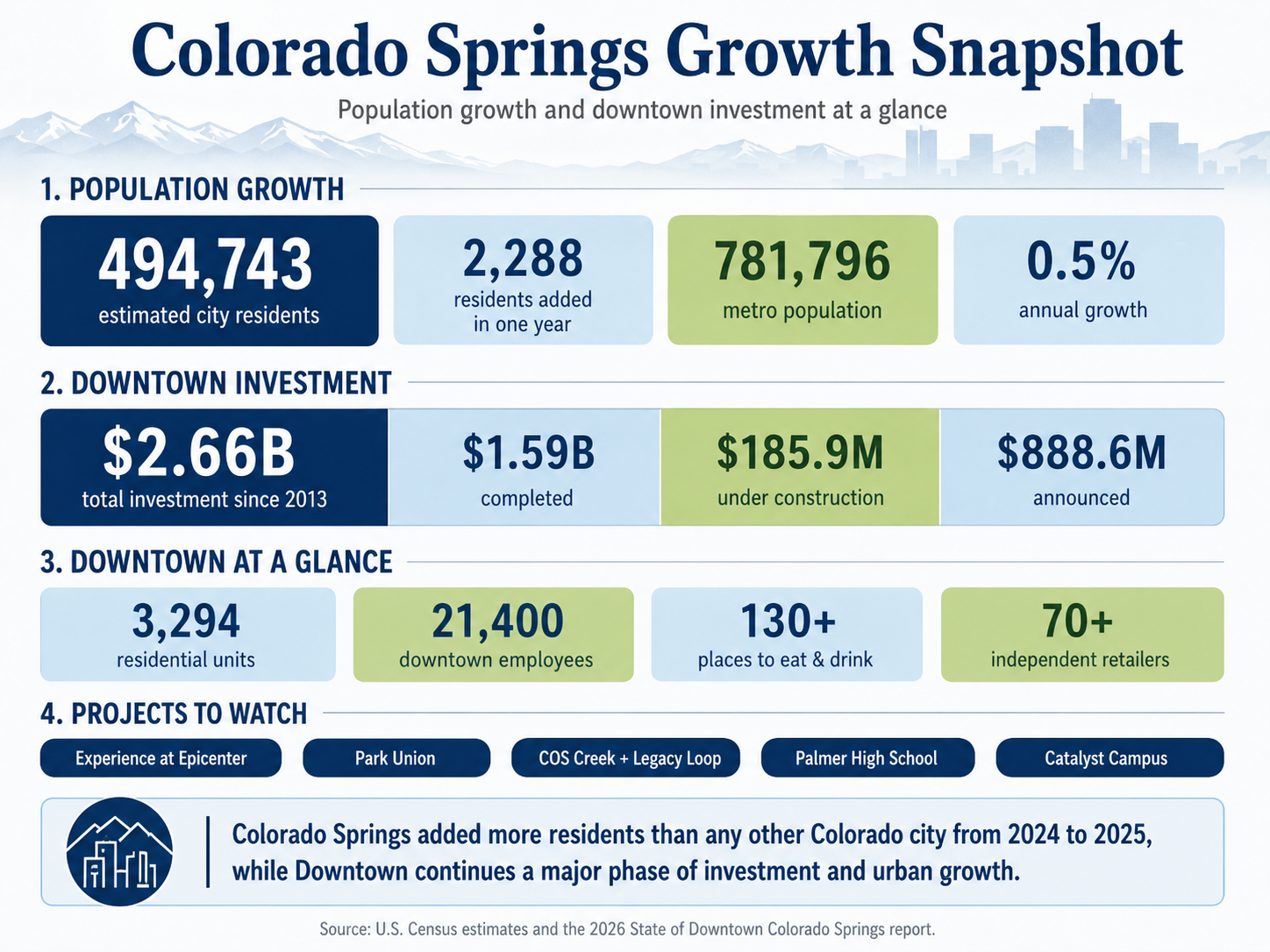
Between July 2024 and July 2025, Colorado Springs added an estimated 2,288 residents, more than any other city in Colorado. That brought the city’s population to approximately 494,743, placing it fewer than 5,300 residents away from the half-million mark.
The annual growth rate was modest at approximately 0.5%, but the numeric increase matters. More than half of Colorado’s municipalities reportedly lost population during the same period, while Colorado Springs continued to add residents.
Colorado Springs may not be growing at the explosive pace seen in previous decades, but it remains one of the state’s most consistent growth centers.
Colorado Springs Growth by the Numbers
The latest population estimates provide several useful benchmarks:
- 494,743 estimated city residents
- 2,288 residents added in one year
- Approximately 14,780 residents added since 2020
- More than 781,000 residents in the metropolitan area
- Colorado’s second-largest city by population
- Fewer than 5,300 residents away from 500,000
Colorado also crossed the 6 million resident mark in 2025. Growth across the state has slowed considerably, but it has not stopped.
Colorado Springs grew slightly faster than Colorado overall, reinforcing its position as a major destination for residents, employers and development.
Why Colorado Springs Continues to Attract Residents
Colorado Springs benefits from a combination of economic stability, relative affordability and access to outdoor recreation.
The city’s employment base is supported by the military, aerospace, defense, cybersecurity, healthcare, education and tourism industries. Housing remains less expensive than in many Denver and Boulder-area communities, although affordability is still a growing concern for local households.
Residents also have direct access to trails, parks and the mountains without giving up the employment, healthcare, shopping and entertainment options of a major metropolitan area.
Commercial interest is following the population growth. The proposed Buc-ee’s location north of Colorado Springs is one of the most closely watched examples. The project still faces approval hurdles, but the proposal reflects how national companies are evaluating the region’s population, Interstate 25 traffic and long-term consumer demand.
More Than $2.6 Billion Is Reshaping Downtown
The city’s transformation is especially visible in Downtown Colorado Springs.
According to the 2026 State of Downtown report, approximately $2.66 billion has been invested in completed, under-construction and announced projects since 2013.
That total includes:
- $1.59 billion in completed projects
- $185.9 million under construction
- $888.6 million in announced projects
- $190.2 million in additional tracked investment since 2024
- More than $360 million in projects delivered during 2025
The investment extends well beyond apartments. It includes hotels, restaurants, schools, offices, entertainment venues, public spaces, trails and major mixed-use developments.
Downtown Is Becoming a Full-Time Neighborhood
Downtown Colorado Springs now has 3,294 residential units, with more than 1,500 additional units announced.
Projects such as ONE VeLa and the second phase of Experience at Epicenter are expected to add hundreds of new homes alongside commercial space and public gathering areas.
This housing is changing downtown from a primarily office and government district into a neighborhood where people live, work, shop, dine and attend events throughout the week.
That residential density matters. More full-time residents create a stronger customer base for restaurants, retailers and neighborhood services beyond normal business hours.
Downtown’s Economy Goes Beyond Housing
Downtown covers only about 1.1 square miles, but its economic footprint is significant.
The district includes:
- More than 21,000 employees
- 4.9 million square feet of office space
- 130-plus places to eat and drink
- 70-plus independent retailers
- 1,119 hotel rooms
- 18.8 million annual visits
- 200 acres of urban parkland
Downtown businesses generated approximately $503.6 million in gross sales during 2025, an increase of 6.7% from the prior year. Thirty-seven businesses opened during the year, including new restaurants, retailers and service providers.
The State of Downtown report also found that the district generates approximately 6.7 times more sales tax revenue per acre than the citywide average. That productivity helps explain why investment in the urban core benefits the broader Colorado Springs economy.
Major Projects to Watch
Several large developments could shape the next phase of downtown growth.
- Experience at Epicenter represents an approximately half-billion-dollar investment planned around Weidner Field, including roughly 1,200 residential units, commercial space and pedestrian plazas.
- Park Union is envisioned as an 82-acre mixed-use neighborhood near the U.S. Olympic & Paralympic Museum and America the Beautiful Park. Long-term investment could exceed $2.5 billion.
- The COS Creek Plan and Legacy Loop would improve the Fountain and Monument Creek corridors, expand recreation opportunities and strengthen connections between downtown and surrounding neighborhoods.
- Palmer High School is undergoing a major multiphase redevelopment designed to preserve its historic character while adding new academic and athletic facilities.
- Catalyst Campus continues to expand as an aerospace, defense and technology hub supporting companies connected to the Air Force and Space Force.
The Bigger Picture
Taken together, the population and investment numbers point in the same direction.
Colorado Springs is approaching 500,000 residents. Its metropolitan area has surpassed 781,000 people. Downtown has attracted more than $2.6 billion in investment, thousands of residential units and a growing mix of businesses, institutions and public amenities.
The city’s next chapter will not be defined by growth alone. It will be defined by how well Colorado Springs manages that growth through housing, transportation, infrastructure, water, public services and thoughtful development.
For residents, homeowners, businesses and real estate investors, the takeaway is straightforward: Colorado Springs is still growing, and Downtown Colorado Springs is becoming an increasingly important part of where that growth is going.